What is AGI? The difference between the AI you use today and the one everyone is waiting for
What AGI is, how it differs from the AI you use today and why businesses should focus on applied artificial intelligence. From the Neurally INK blog.
 Martina BiscuolaCMO · NeurallyAI6 min read
Contents
An AI model can win a medal in a maths competition and, the same afternoon, fail a task any child solves in a second. This is the paradox of artificial intelligence today: extremely powerful within a narrow field, surprisingly fragile when asked to step outside its own “fence”. This is exactly where one of the most overused, and often least understood, acronyms of the moment comes in: AGI, artificial general intelligence.
It is talked about as the next big revolution, and often confused with the AI that companies already have in production. But AGI does not mean “a more powerful AI”: it means a different AI. Understanding this difference helps you decide, today, what to invest in and where, instead, to wait. Let’s clear things up in this Neurally INK article.
What is AGI?
AGI is a (still hypothetical) stage in the development of artificial intelligence in which a system can match or exceed human cognitive abilities in any activity. It is the underlying goal that AI research has pursued for decades: to artificially replicate a general intelligence, comparable to that of a person.
It is described as a theoretical field of research that aims to create software able to learn on its own and to solve problems that were not foreseen during training. It is important to remember that this is a hypothetical form of AI, capable of critical thinking and of cognitive functions equivalent to human ones, which does not yet exist today. In fact, there is currently no universally agreed definition of AGI, nor any consensus on whether current systems have reached this level.
The distinction that changes business decisions: narrow AI vs AGI
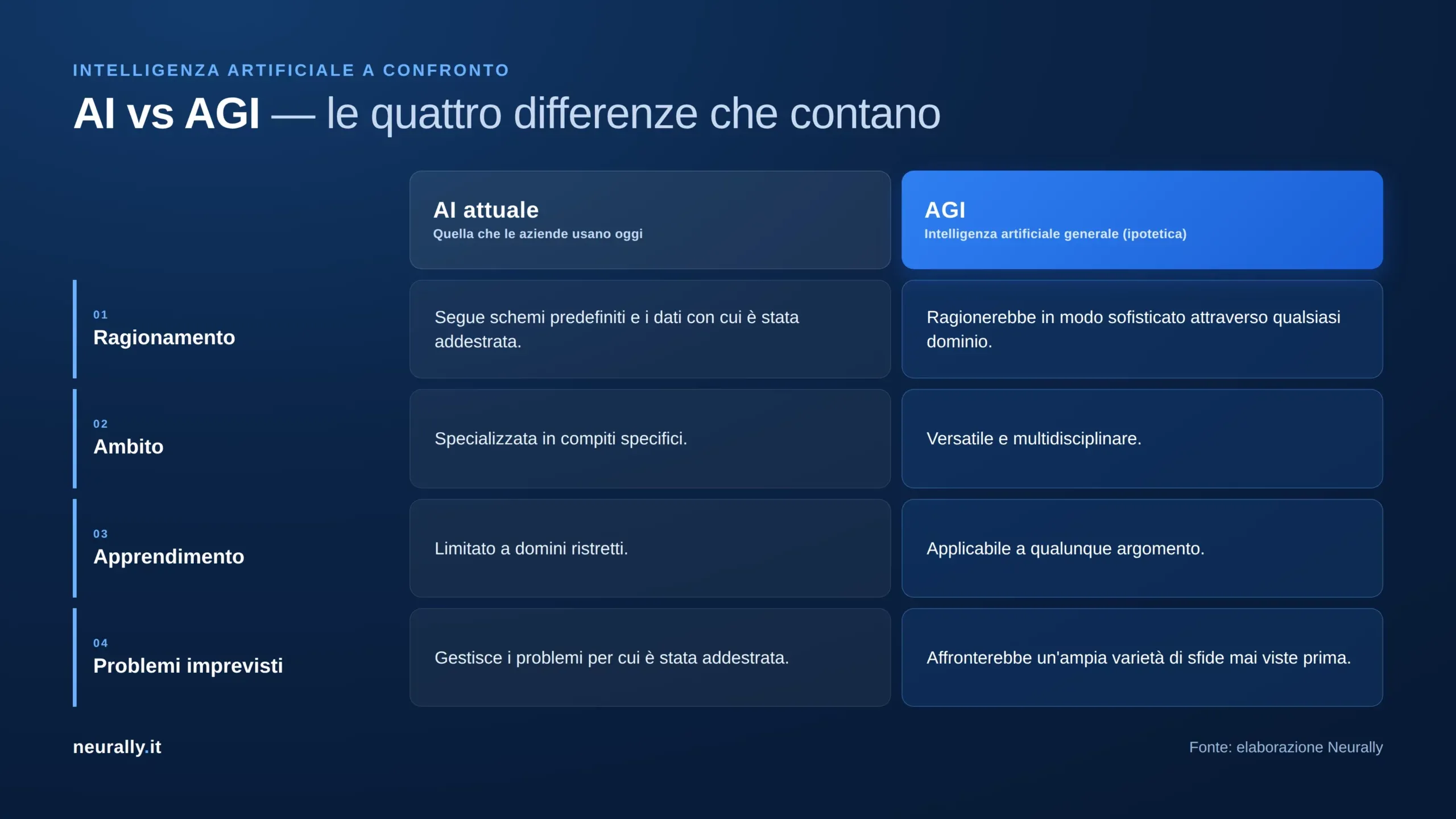
The AI we use every day is what experts call narrow AI (also “weak AI”): intelligence applied to specialised domains, such as classifying documents or answering a customer. It works very well, but only within the boundaries it was designed and trained for.
AGI, by contrast, would have generalised abilities that go beyond the boundaries of a single task. We can summarise the differences like this:
So what should an AGI actually be able to do?
For a system to count as AGI, it would need to master a set of abilities that we take for granted in humans but that remain far beyond today’s machines. The current picture is: autonomous learning from new experiences in real time, flexible problem-solving across different domains, adaptability to tasks never faced before, understanding of context and motivations, reliable reasoning and persistent memory.
On top of these come the more “human” dimensions, such as complex sensory perception, emotional intelligence, genuine creativity and, above all, the ability to transfer knowledge from one domain to another. This cross-domain connection is one of the hardest obstacles, because current models, however advanced, struggle to carry what they “know” in one field into a completely different one.
Where are we with AGI? Experts and critics
This is where the debate heats up. On one side, some researchers argue that large language models have already reached a form of AGI, because their distinctive feature, generality, is now evident: they work on a huge variety of tasks. On the other, critics reply that generality is not enough without reliability: Yann LeCun, the French computer scientist and one of the most authoritative voices in the field, observes that language models lack common sense and cannot act in the real world, and that a system trained only on language will never truly reach human intelligence.
As for “when”, forecasts have changed quickly and keep changing. Until a few years ago the consensus placed AGI beyond the end of the century, but a 2023 survey of 2,778 researchers estimated a 50% probability that machines will outperform humans at every task by 2047. A date that is as close as it is uncertain because, as the experts themselves remind us, forecasts in their own field have historically proved unreliable. The most honest summary remains ServiceNow’s: a usable AGI is still a long way off.
AGI, ASI, strong AI, agentic AI: a short glossary to avoid confusion
AGI comes with a vocabulary that causes plenty of misunderstandings, and telling the terms apart helps you find your way through the news:
- Strong AI emphasises the machine’s awareness and consciousness
- AGI, instead, focuses on general performance, whether or not there is any consciousness
- Artificial superintelligence (ASI) is the next stage: it does not match human abilities, it surpasses them, and AGI would be its prerequisite, not the other way round.
Finally, be careful not to confuse AGI with agentic AI. Autonomous agents carry out complex, multi-step tasks, but within specific domains, and they are already a concrete lever for automation today. AGI, by definition, transcends any particular domain. This is a substantial difference: agents are an operational reality, while AGI remains a research horizon.
Let’s focus on today’s AI
If AGI is still so far away, companies need to ask themselves: “what can I do now with the AI that exists?”. And the answer is: a great deal. Mature applications already include the automation of complex workflows, virtual agents available 24 hours a day for customer service, automatic classification and routing of requests, extracting insights from company data and a measurable reduction in operating costs. And that’s not all!
Real competitive advantage has to come from putting today’s specialised intelligence to work properly, starting from well-defined processes, organised data, clear and measurable goals, and governance that balances power and responsibility. This is where the gap between those who “try AI” and those who turn it into results becomes obvious.
Since AGI is a fascinating goal that still has no agreed definition, it makes sense to look at it as a compass, to understand where the technology is heading. Waiting for it as a deadline before you start using AI does not.
So, for businesses, the real opportunity is AI applied well, with method and governance. That is what we do at Neurally every day, helping companies and public bodies turn artificial intelligence into concrete projects that automate processes, with quality, ethics and regulatory compliance at the centre.
If you’d like to understand which AI use cases can really make a difference in your company, without waiting for AGI, discover our solution, Neurally.
Keep following Neurally INK for insights, analysis and the behind-the-scenes stories of artificial intelligence.
 Written byMartina Biscuola · CMO and co-founderBackground in sales and communication: she manages brand positioning and communication, and supports compliance and subsidised finance.
 Martina Biscuola