Why do AI agents work better as a team? Multi-agent systems
Interest in multi-agent systems is soaring. What are they, where do they work and how do you stop the project from failing? Neurally explains.
 Martina BiscuolaCMO · NeurallyAI10 min read
Contents
Everyone wants agents, but few have worked out how to get them into production, let alone how to keep them there. Between the first quarter of 2024 and the second quarter of 2025, Gartner recorded a 1,445% increase in client enquiries about multi-agent systems. A few months earlier, it predicted that over 40% of agentic AI projects will be cancelled by the end of 2027. In this Neurally blog post, we explain the reasons behind that prediction. Let’s start.
What is a multi-agent system?
A multi-agent system (MAS) is an architecture in which several AI agents, each with a specific task, interact to reach a common goal. They are defined as “a set of AI agents that interact to achieve complex goals, whether individual or shared”.
Anyone who lived through the move from monoliths to microservices has seen this film before. Instead of a single agent trying to do everything, with a three-page prompt and ten connected tools, the process is broken down:
- one agent reads and classifies incoming documents;
- a second extracts the data and normalises it;
- a third checks it against the ERP;
- a fourth drafts the reply;
- an orchestrator decides who works, in what order, and when to stop and call in a person.
Each agent can be tested, measured and replaced on its own, and when something breaks, you know where to look.
Why can’t a single AI agent cope?
The answer lies in the snowball effect of errors (known as error compounding): when a single model has to plan, execute and check a complex workflow, one small hallucination at the start is enough to compromise the entire result. Without external checks, the agent suffers from context drift (losing focus over long tasks) and ends up uncritically validating its own mistakes.
So a single agent works well on short tasks, while on multi-step processes the problems add up.
To fix this structural fragility while also optimising computing costs, the market is moving towards multi-agent architectures (MoA), where work is split among specialised models and one agent’s output is validated by another, eliminating single points of failure.
Indeed, a Gartner study predicts that by 2027, 70% of multi-agent systems will use agents with very narrow specialisations. Accuracy will improve, of course, but so will the complexity of coordination. It is the trade-off of any distributed system: more components mean more reliability at each point, and more work on the interfaces between them.
The three maturity stages of multi-agent systems
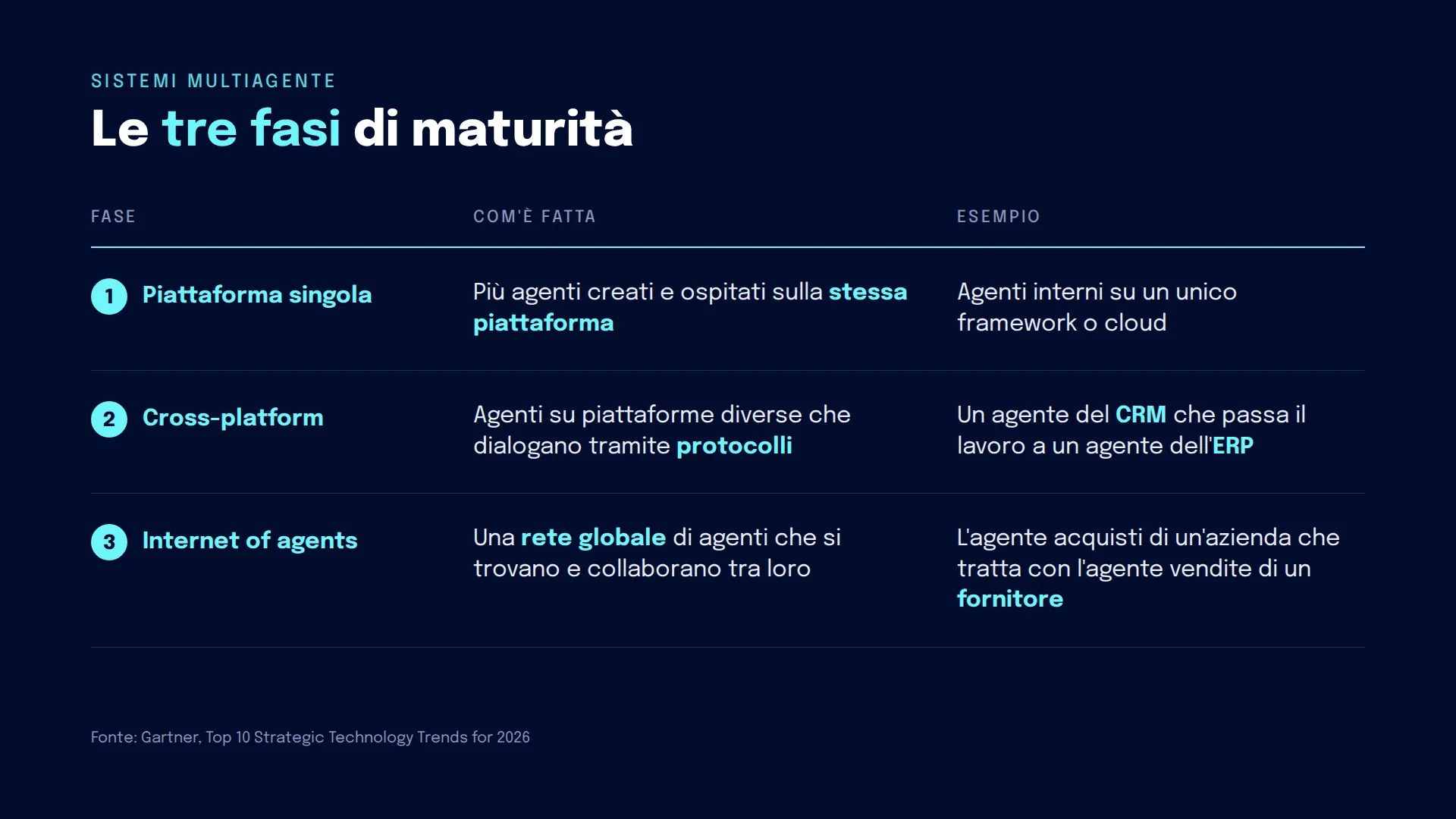
In Italy, almost all systems are still at stage 1. The Osservatorio Artificial Intelligence at Politecnico di Milano estimates that in 2025 agentic AI accounted for just 4% of an Italian AI market worth €1.8 billion. Those who move now, with a clear method, gain strategic ground.
MCP and A2A: the protocols that make stage 2 possible
For agents from different vendors to work together, common standards are needed. Two are emerging today.
- Model Context Protocol (MCP) connects an agent to tools and data: databases, APIs, files, business applications. In December 2025 it was donated to the newly founded Agentic AI Foundation, a Linux Foundation project.
- Agent2Agent (A2A) handles the dialogue between agents. Each agent publishes an agent card, a profile describing what it can do and how to reach it, and other agents can delegate tasks to it. A2A reached version 1.0 in March 2026 and joined the Agentic AI Foundation on 17 August 2026.
Gartner predicts that by 2028, 60% of multi-agent systems will support interoperability between different vendors. There is one limit to bear in mind, though: protocols standardise communication, not permissions. Whether an external agent may read an order or change a customer record is still decided by the company, under its own policies.
Where do multi-agent systems actually work?
Multi-agent systems perform best on repetitive, multi-step processes, where people currently spend their time copying data from one system to another. Here are a few examples:
- Order-to-invoice cycle: specifically order capture, checking availability and terms, credit checks, invoicing and reconciliation.
- Technical quoting in manufacturing: reading the specifications, extracting the requirements, costing from the bill of materials, drafting the offer.
- Second-level customer support: classifying the ticket, searching the knowledge base, diagnosing from the logs, proposing a solution for a technician to validate.
- Document due diligence: in particular contract analysis, comparing clauses with internal standards, flagging exceptions to the legal team.
The selection criterion is always the same: a defined process, with measurable inputs and outputs, and a clear point where a person approves.
Why multi-agent projects fail: 5 causes in depth
Sometimes, however, multi-agent projects are derailed by problems that can lead to outright failure:
1. Rising costs: a chatbot answers a question with one call to the model, whereas a multi-agent system can make 20 for the same request. The orchestrator plans and the agents work in parallel. Another agent checks the result and, if it isn’t right, sends everything back. At every step the context travels from one agent to the next, and at every step you pay for tokens. The problem is not the cost itself, but its shape. In a pilot with a hundred requests a day, for example, the bill is negligible. In production, with ten thousand requests and the edge cases the pilot never met, costs grow faster than volumes. In multi-agent projects, the finance function’s tasks include managing unpredictable costs and funding observability tools, setting a spending cap for each run and measuring the cost of each agent, to avoid nasty surprises on the bill.
2. Unclear business value. Many projects start from the wrong question: “What can we do with agents?” instead of “Which process is costing us too much?”. The result is a convincing demo that doesn’t move a single line of the P&L, and the typical symptom appears after the pilot: when it is time to move into production and someone asks how much it saves, the answer is “it depends”.
According to the Osservatorio Artificial Intelligence at Politecnico di Milano, 71% of large companies have launched at least one AI project, but only 20% have managed to roll it out widely across several business functions. The gap between the two figures is largely made up of projects that never proved they were worth their cost. So what can we do? Focus on company-wide productivity rather than simply enhancing individual tasks: an agent that saves someone ten minutes is a convenience, while a system that cuts a quote cycle from 5 days to 1, for example, is a competitive advantage.
3. Inadequate risk controls: an agent that writes, meaning one that updates a customer record, emails a client or approves a payment, needs close attention. In multi-agent systems the problem multiplies, because each agent has its own permissions, and a malicious instruction hidden in a document can pass from one agent to the next until it reaches the one with access to the ERP. This is prompt injection, and it is why every company should count AI security platforms among its strategic moves. The most underestimated risk, though, does not come from outside. A Gartner study predicts that 80% of unauthorised AI transactions will stem from internal policy violations, not external attacks: sensitive data fed into a model, agents configured with more permissions than they need, automations triggered without any approval. Then there is the regulatory framework. The EU AI Act requires traceability and human oversight for many use cases, so a system that doesn’t record who decided what, and on the basis of which data, will not be compliant. Indeed, according to Istat (the Italian National Institute of Statistics), regulatory uncertainty is holding back 47.3% of the Italian companies that have considered AI without adopting it.
4. Models not yet mature. In mid-2025, researchers at Carnegie Mellon tested AI agents on realistic office tasks with the TheAgentCompany benchmark: the best model completed about 30% of them. Over the same period, Salesforce’s CRMArena-Pro benchmark recorded a 58% success rate on single-step tasks, falling to around 35% in multi-turn conversations. Models have improved since then, but the principle still holds. The reason is arithmetic, and anyone who has designed a distributed system will recognise it at once: an agent that is 90% reliable on a single step, placed in a chain of five steps, completes the whole process correctly 59% of the time. With ten steps it drops to 35%, as the errors add up. That is why the companies getting results don’t wait for the perfect model; they design for errors: highly specialised agents, automatic checks between one step and the next, confidence thresholds below which the work passes to a person. By 2027, 70% of multi-agent systems are expected to use agents with very narrow specialisations, precisely because a smaller task is harder to get wrong.
5. Hype-driven experiments
“Most agentic AI projects today are hype-driven experiments or proofs of concept, and they are often misapplied.” Anushree Verma, Senior Director Analyst, Gartner.
A pilot often starts because the board asked “what are we doing with agents?”, not because a process really needed one. It is handed to an innovation team with no access to production data, lasts a few months, produces a demo and ends up in a drawer. The phenomenon is also fuelled by vendors, through so-called agent washing: assistants, chatbots and RPA rebranded as “agents” without having their capabilities. Of the thousands of vendors presenting themselves as agentic AI providers, only around 130 are estimated to offer real solutions. So how do you spot them? Simply ask the vendor to show you what happens when the agent gets something wrong: how it notices, who it hands the work to, what stays in the logs. If the answer is a slide, you are looking at a chatbot with a different name.

The costs of multi-agent systems
A multi-agent system consumes tokens at every handover between agents. A badly written retry loop can send the cloud bill soaring overnight. It is no coincidence that the tasks a company should assign to its finance function explicitly include managing “unpredictable costs” and funding observability tools.
Three practical rules are worth putting in place:
- a maximum budget per run, with an automatic stop if it is exceeded;
- per-agent metrics: latency, cost, error rate, escalation frequency;
- complete traces of every run, to reconstruct who decided what and why.
Large enterprises and SMEs: same trend, two different paths
Italian data show two speeds. According to Politecnico di Milano, 71% of large companies have launched at least one AI project, but only 20% have rolled it out widely across several business functions. Among SMEs, projects involve 15% of medium-sized and 7% of small companies.
For a large enterprise, the problem is not getting started, since the pilots already exist, but getting beyond them. It needs a shared platform, interoperability rules and an agent catalogue, so as not to end up with several projects that don’t talk to each other.
For an SME, the most sensible path is vertical: one process, two or three agents, one person supervising. It makes little sense to buy an enterprise platform to automate expense claims.
How to bring in multi-agent systems in 5 steps
- Start from ONE well-defined process, with an owner and a KPI.
- Build modular agents, specialised, replaceable and testable on their own.
- Put governance and observability in place from day one: API governance, monitoring, decision logs.
- Choose open standards, today MCP and A2A.
- Train the people who work alongside the agents: they need to know when to trust them and when to step in.
Do you have a process that eats up hours of copying and pasting between different systems? Tell us about it in 30 minutes. Together we’ll assess whether it suits a multi-agent system.
Contact us now
 Written byMartina Biscuola · CMO and co-founderBackground in sales and communication: she manages brand positioning and communication, and supports compliance and subsidised finance.
 Martina Biscuola