AI document search: how to find answers without losing control of your company know-how
You can use AI document search without exposing company data. Discover Neurally: verifiable answers and protected know-how.
 Martina BiscuolaCMO · NeurallyBrand identity6 min read
Contents
Every company holds hundreds of pieces of information that it often needs to access quickly and efficiently: data in contracts, manuals, minutes and reports built up over the years. The problem is sometimes the time it takes to find this information and, more and more often, the risk of exposing it in the rush to do so. This is exactly where AI document search changes the rules of the game, provided you choose the right tool.
In this Neurally INK article, we look at what AI-based document search is, why public tools are becoming a security problem for companies’ information assets, and how the AI agent platform Neurally gives you immediate, verifiable answers without your data slipping out of your control.
The real problem isn’t the data, it’s finding it… in time!
In knowledge-intensive organisations, knowledge grows faster than the ability to organise it. Qualified people who should be focusing on decisions and oversight end up spending a surprising share of their working time on a low-value activity: looking for information the company already has, without knowing exactly where it is stored.
The result is twofold: on the one hand, valuable time is wasted; on the other, to speed things up, staff turn to shortcuts that open up a much bigger risk. This is where intelligent document search stops being just a matter of productivity and becomes a matter of governance.
What is AI document search?
Traditional document search works by keywords: you type a term and the system returns the files that contain it. It is then up to you to open them, read them and work out whether the answer is really in there.
AI document search, by contrast, gives you answers instead of looking for documents. You ask a question in natural language, as you would ask a colleague, and the system understands the intent, finds the relevant information even when it is spread across several files, connects it and returns an output. Instead of a list of results to trawl through, you get an answer that is ready to use.
With the arrival of AI agents, this process becomes autonomous: the agent doesn’t just retrieve text, it reasons about the content, cross-checks different sources and verifies that what it proposes is consistent. It is the difference between a search engine and a digital colleague who reads the whole archive for you.
The dark side of AI: Shadow AI and know-how leaks
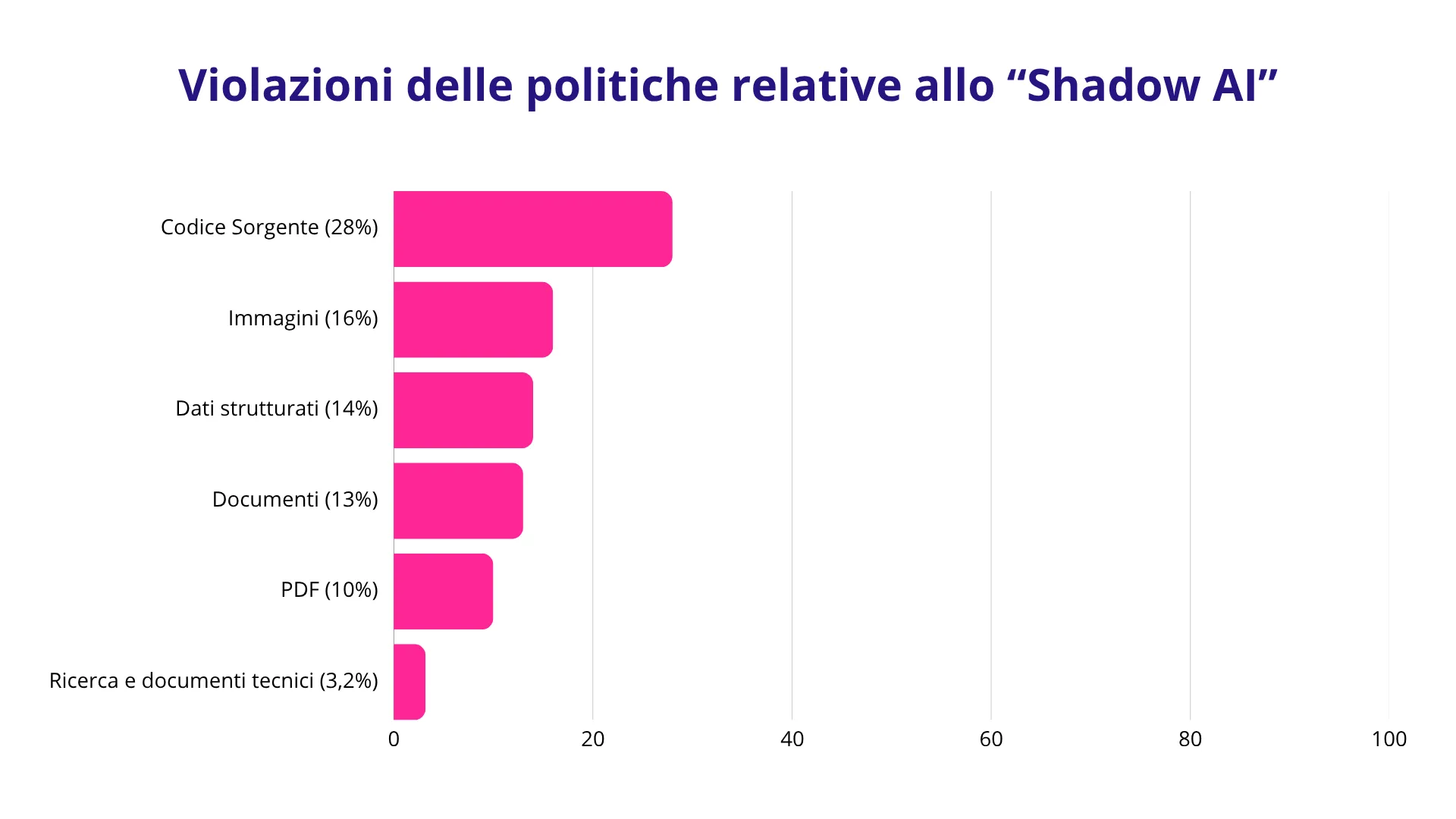
There is, however, a flip side that too many companies discover too late. In an effort to work faster, employees upload company documents to free public chatbots to summarise a contract, for example, prepare an offer or generate a presentation. This is known as Shadow AI: the use of AI tools that the company has not authorised.
The numbers show the scale of the problem: according to Verizon’s Data Breach Investigations Report 2026, 67% of employees who use AI for work do so with unauthorised personal accounts, and Shadow AI is now the third most common cause of non-malicious data loss in organisations. In the space of a year, regular users of generative AI went from 15% to 45%.
The paradox is that the end result resembles an external cyber attack: strategic information such as projects, business plans and trade secrets leaves the company perimeter, often for servers in non-EU jurisdictions, where it can be stored and reused beyond the company’s control. Except that here there is no hacker, just a well-meaning person who “only wanted to save time”. The new insider threat, then, is not the disloyal employee but the efficient one.
What Neurally can change
After months of research, development, testing, validation and improvement, the Neurally platform was born. It is the result of shared work across our start-up, a solution that has also been put before international professionals and is bringing us real satisfaction. The platform was created to give people who work in companies the convenience of AI document search without the risk of their data being dispersed.
Companies can use Neurally to bring company knowledge together and give every department timely access to information that can then be exported or reworked. It is all tailored, because each department can have its own AI agents and prompts for specific tasks. And, of course, everything happens within your company’s own workspace.
We can sum up how Neurally works in 4 points:
- Set up the platform with agents, prompts, connections to company knowledge and access permissions
- Ask in natural language by typing your question or calling up the prompts you have created
- The AI agent searches and reasons, analysing the entire document base (or the part selected for it), identifying the relevant information, cross-checking sources and building a coherent answer.
- Get a verifiable answer in a few seconds, concise and backed by the exact citation of the source document.
The difference from a generic chatbot is substantial: instead of a tool that works on generic data taken from the web, you have an agent that reasons only on your company’s documents.
Secure document search: Neurally’s 3 principles
For a company whose competitive advantage lives in its documents, knowledge security is the very condition for adopting AI. Neurally is built around 3 essential principles.
- The first is that your data stays under your control. The agents work within your company’s own workspace, on servers in Italy, and your documents are not used to train AI models. Your knowledge stays yours.
- The second is verifiability. Every answer cites the source it comes from, so no decision is made on the basis of invented or untraceable information, a real risk with generic tools.
- The third is governance. Traceability of who asks what, access control and transparency, designed for the people in the company who are responsible for data protection.
Which companies is Neurally designed for?
Neurally performs best where knowledge is both an asset and a risk, from advanced manufacturing and mechatronics to pharmaceuticals and life sciences, professional services firms, financial services and the public sector. In general, any organisation with know-how to protect and large volumes of documents in areas such as legal, compliance, R&D, HR and procurement is a typical potential user of the platform.
In sectors like these, the answer is not to ban AI, as we have sometimes seen happen, because people will use it anyway. The real answer is to govern it, by offering in-house a better and safer tool than the ones employees would find on their own.
Neurally gives you the speed of instant answers and the security of know-how that stays in your hands.
All that’s left is to try it, with a 7-day free trial, or you can book an in-depth call to explore real use cases and get to know us.
Try Neurally
 Written byMartina Biscuola · CMO and co-founderBackground in sales and communication: she manages brand positioning and communication, and supports compliance and subsidised finance.
 Martina Biscuola