How generative AI works: a guide for non-experts
How does generative AI work, and what are its limits and potential? Find out in our guide for non-experts on the Neurally INK blog.

Contents
Imagine being able to create an image or a text in a few seconds, without drawing or writing, while dealing with software that understands and responds as a human would. This is the world of generative AI, a technology that seemed like science fiction just a few years ago and is now available to everyone. Today generative AI is everywhere, from social media to healthcare, from marketing to entertainment.
But how does it really work? And, above all, how can someone without technical experience understand and make use of this innovation? In this guide for non-experts we explain, simply and clearly, how generative AI works, what its limits are and what potential it has to revolutionise our world.
What is generative AI?
Generative AI is a branch of artificial intelligence that works through advanced models that learn from data and can create new content. These models include generative neural networks and language models such as GPT. They are trained on large amounts of data (such as text, images or sounds) to recognise patterns and structures.
For example, if we ask a model like GPT to continue a sentence or tell a story, it can respond quickly and fluently, almost as a human would. This is possible because the model has “learned” the structure of language by practising on a vast amount of text.
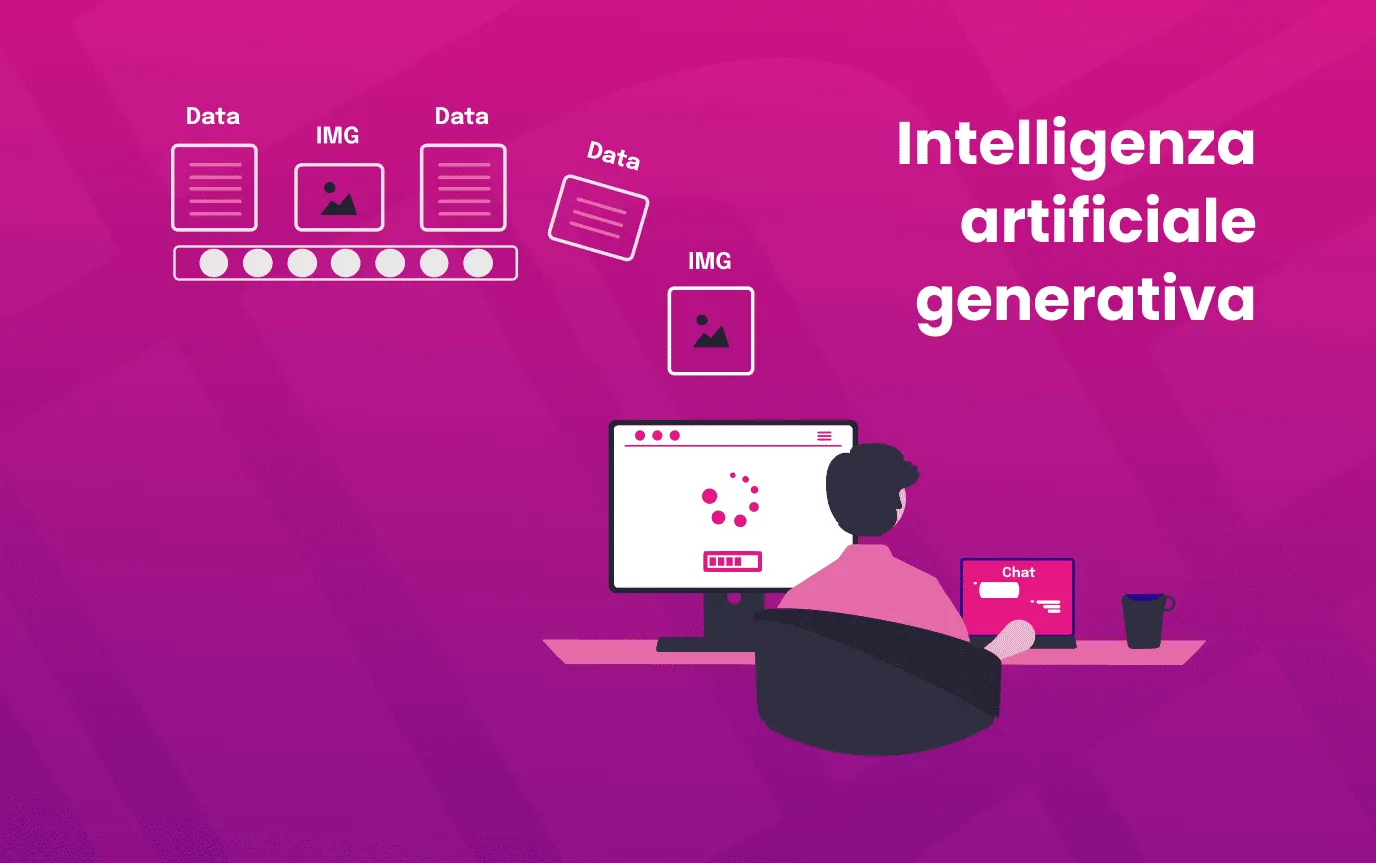
Data and training: the secret of generative AI
The secret of generative AI lies in the data it uses. The more high-quality data the model can process, the better the results. During training the model “reads” a huge number of texts or images, learning to recognise the patterns it will later reuse to respond to requests.
There are two main training phases:
- pre-training, in which the model learns the basics, such as grammatical structures and the relationships between words in a sentence.
- fine-tuning, a more specific phase in which the model is trained to improve in a particular field.
A tour of the practical applications of generative AI
Generative AI already has a great many applications, and the number keeps growing. Here are some of the main ones:
- Text generation: from virtual assistants that can converse like humans to tools that write complete articles, generative AI helps support communication, speed up work and handle repetitive tasks.
- Image creation: models such as DALL-E or Midjourney can create realistic or artistic images from a simple description (prompt), becoming a support for designers and creators.
- Music and audio composition: generative AI can create music or sound effects, opening up new possibilities for music production and entertainment.
- Programming assistance with language models such as Codex, which can write computer code from simple instructions.
Going deeper, there are other applications where this technology is finding a place, such as advanced maintenance management, for example to understand how worn industrial components are, or supporting a company’s employees with document management, so they can get information quickly.

So what are the limits?
Despite continuous technological progress, generative AI systems have some limits, so users should pay close attention to avoid being misled by biased or inaccurate content. It is precisely to address issues like these and to support an informed use of artificial intelligence models that the AI Act will come into effect by 2026.
Bias and ethical issues
Generative AI can reflect any biases present in the data it was trained on, leading to unfair or problematic answers.
Difficulty controlling content
Generative models sometimes produce unexpected or inappropriate results, because they do not truly understand the meaning of the content or of the requests made.
Copyright issues
Because it is trained on existing data, generative AI may produce content similar to other people’s work, creating intellectual property problems.
Data confidentiality
Generative AI can pose risks to data privacy and security, especially when it uses sensitive or personal information handled on servers whose location we do not know. If the data a model is trained on includes confidential information, it could accidentally generate content that reveals it, compromising confidentiality.
The future of generative AI: what lies ahead?
According to the Politecnico di Milano Observatories, in 2023 generative AI was used by only 5% of Italian companies. There is also a wide gap between large enterprises, which invest in advanced tools and skilled staff, and SMEs, which struggle to get started in this field, both because of a lack of resources (only 20% of Italian companies manage to hire staff with the right skills) and because of limited knowledge of and distrust in AI (66%).
Another obstacle to the development of these technologies is concern about data management, because of its complexity and fragmentation, and above all about security.
According to the Strategia Italiana per l’Intelligenza Artificiale 2024-2026 (Italy’s national AI strategy), an optimised plan for the country requires the right steps for research, public administration, businesses and training. Only by setting a strategy for each of these players will it be possible to achieve advanced technological development that keeps pace with other countries around the world.
In this guide we have therefore identified two of the limits and concerns of generative AI: problems with the context the models refer to and data privacy. What if we told you we have a solution that addresses both? Take a look at Neurally, our advanced and private virtual assistant!


 Martina Biscuola