The future of artificial intelligence: the 2024 Nobel Prize in Physics
How the 2024 Nobel Prize in Physics laid the foundations for the future of AI, and how Hopfield and Hinton revolutionised machine learning.
Contents
The future of artificial intelligence is taking shape thanks to pioneers such as John J. Hopfield and Geoffrey E. Hinton, awarded the 2024 Nobel Prize in Physics. Using tools from physics, they developed methods that today underpin machine learning. Their discoveries are shaping a technological revolution that will change the world as we know it. In this article we look at the contribution of these pioneering scientists, to shed light on what the future of artificial intelligence will look like.
Machine learning: the evolution of artificial intelligence
Artificial intelligence has roots going back to the 1950s, when pioneers such as Alan Turing asked whether machines could “think”. Since then there have been many attempts to imitate human thought, but it was only with the development of machine learning that AI began to make real progress.
Machine learning is the beating heart of modern artificial intelligence. It is the branch of artificial intelligence that makes it possible to build systems that learn and improve their performance based on the data they use.
Learning systems fall into two categories:
-
Supervised learning: think of a small child. With supervised learning, you want to teach the child what an apple is, as opposed to a pear, by showing them the objects so that, under the supervision of whoever is teaching them, they learn to tell the two fruits apart. Just like the child who learns this distinction under an adult’s supervision, supervised learning relies on precise inputs to train models. The data examples provided teach the system how to recognise, classify and solve specific problems.
-
Unsupervised learning: taking the child example once more, with unsupervised learning the child learns from their own experience, without an “instructor” supervising their progress. Unsupervised learning is like a child left to explore alone, learning from the objects around them without instructions. This approach allows machines to identify patterns and information without explicit guidance.
These two concepts are the foundation of machine learning: thanks to them, AI models are becoming increasingly intelligent and can understand and carry out different tasks, depending on the type of learning used. In self-driving systems, for example, cars learn to distinguish between pedestrians, road signs and vehicles; in medicine, AI can analyse diagnostic images to identify problems with ever-greater accuracy.
The Hopfield network: artificial memories inspired by the human brain
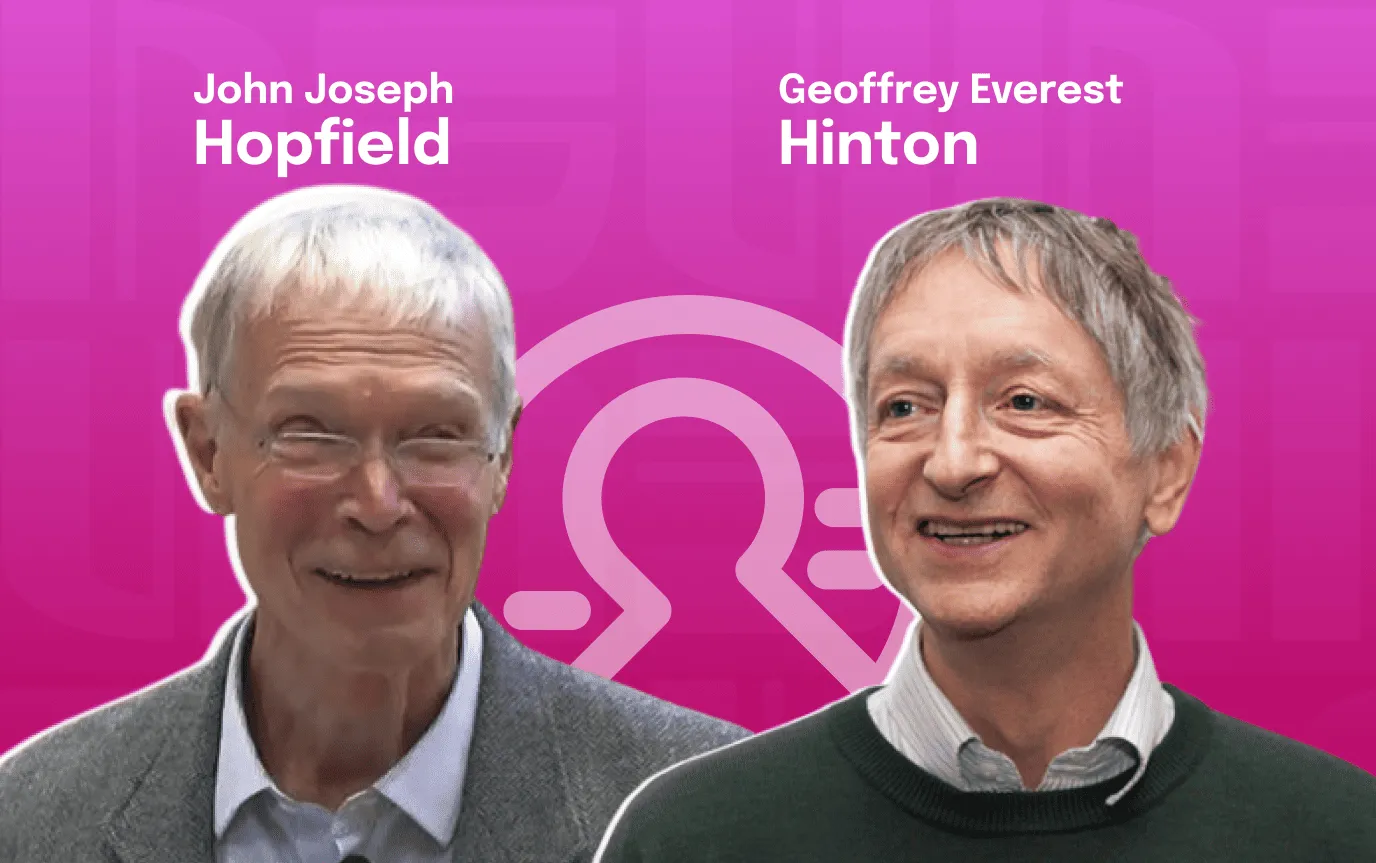
John J. Hopfield is an American physicist and neuroscientist known for his fundamental contributions to the field of artificial neural networks. Hopfield’s Nobel-winning contribution lies, besides advances in computational biology, in the creation of the so-called Hopfield network, a type of artificial neural network that uses a method to store and recreate recurring patterns, simulating the human brain’s ability to remember things or reconstruct distorted images. This capability was made possible by the introduction of associative memory, which can remember data patterns and has a method for recreating them.
The Hopfield network uses the physics that describes a material’s characteristics due to its spin (the property that makes each atom a tiny magnet). The network as a whole is described in a way equivalent to the energy in a spin system, and is trained to find values for the connections between the nodes so that the stored images have low energy. When the Hopfield network is given a distorted or incomplete image, it works methodically through the nodes and updates their values so that the network’s energy decreases. The network thus works step by step to find the stored image most similar to the imperfect one it was fed.
Geoffrey Hinton’s contribution: a bridge between psychology and AI
Geoffrey Hinton is one of the pioneers of artificial intelligence and machine learning, best known for his revolutionary contributions to deep neural networks and deep learning. Hinton came across John Hopfield’s research after a long period studying psychology, wondering whether machines could learn to process information in a similar way to how humans actually do, and over the years he found new systems for categorising and interpreting new information.
Using statistical physics, Hinton built on Hopfield’s work by drawing on the fundamental theory used to describe systems made up of many similar components. With this theory and the equation of the nineteenth-century physicist Ludwig Boltzmann, which describes the probability distribution of particles in a physical system, where some states (configurations) are more likely than others depending on their energy, it becomes possible to determine that some states of the components that make up a system are more likely than others.
These two models laid the foundations for a true machine learning revolution, supported by the enormous computing power available today and by the vast amounts of data we have to train these models.
The future of artificial intelligence: endless possibilities
These discoveries open up extraordinary prospects for the future of artificial intelligence. Advances in machine learning, driven by the work of pioneers such as Hopfield and Hinton, promise to transform sectors such as healthcare, finance, public administration, automation and many others. What we are living through is only the first phase of a technological revolution that will have enormous repercussions on our world. However, the path towards further advances in these technologies also brings ethical and technical challenges, which developers and regulators will need to address with care and precision.
We leave you with a question: do you think neural networks can really surpass human abilities in certain fields and define the future of artificial intelligence?
If you’d like to answer and share your opinion, do it here.
 Martina Biscuola