Computer vision: the technology revolutionising business
What computer vision is, how it works and how companies use it: the main tasks, applications by industry and the trends of the coming years.
 Martina BiscuolaCMO · NeurallyAI5 min read
Contents
Years ago, would you ever have imagined that machines and computers could see and understand the world? Today it is possible thanks to a technology called computer vision, a branch of artificial intelligence that is revolutionising the way we manage many aspects of our lives. Here we focus on how companies manage production processes, security and the analysis of visual data with computer vision. With advances in artificial intelligence and computing power, this technology keeps progressing and is more accessible than ever, offering concrete benefits in many industries. In this article you will find everything you need to know on the subject. Let’s begin!
What is computer vision?
Computer vision is a branch of AI that uses machine learning and neural networks to teach computers to interpret visual data, such as images and video. The information extracted can then be processed to improve decisions in many areas.
This technology has become essential because tasks that require constant attention, such as spotting defects or patterns, can be hard for humans, who are prone to fatigue and distraction. Computer vision, on the other hand, works quickly and precisely, analysing large amounts of data without a break.
The history of computer vision goes back to the 1950s.
How does computer vision work?
Computer vision lets computers interpret and understand images and video through advanced algorithms. Modern computer vision is built on powerful machine learning algorithms and, in particular, deep learning. Convolutional neural networks (CNNs), inspired by the human visual cortex, are especially effective at analysing visual data. The typical process includes:
- Image acquisition: cameras, LiDAR sensors or infrared devices capture images and video streams, providing detailed visual data
- Pre-processing: the data is improved through colour normalisation, noise reduction and segmentation, preparing the images for analysis
- Processing and analysis: deep learning algorithms and convolutional neural networks analyse the visual data and identify patterns, objects and anomalies. Advanced technologies such as YOLO and Mask R-CNN improve detection and segmentation in real time
- Output/action: once the relevant data has been extracted, the system can make autonomous decisions, for example identifying defects in industrial products or detecting abnormal behaviour by an individual in a monitored area.
Developing computer vision solutions also involves several challenges. For example, the algorithm must be able to assign the most appropriate label to what it detects, or to outline and analyse different entities within the image, as well as identify them. To address these issues, you need a dataset large enough to train the algorithm, and you need to teach it to understand the image even under particular transformations, such as poor lighting or a partially hidden subject.
Essentially, the effectiveness of these systems depends heavily on the quality and quantity of training data and on the computing power available.
The main computer vision tasks
-
Image classification: analysing the content of an image and assigning it a label (take a look at our software, Neurally)
-
Object detection: locating one or more objects within an image
-
Image segmentation: dividing the image into distinct areas, for example to highlight the pixels of a medical scan that show an anomaly
-
Face recognition: recognising and identifying faces
-
Action recognition: detecting entities and their interaction over time and space, useful for describing specific actions
-
Visual relationship detection: understanding the relationships between objects in an image
-
Emotion recognition: analysing the emotions conveyed by an image
-
Image editing: modifying images, for example blurring out sensitive data.
At present, companies focus mainly on image classification and object detection solutions.
How to make the most of computer vision
The applications of computer vision are many, and they are evolving fast:
- Security and surveillance, through advanced facial recognition systems and the identification of suspicious behaviour that improve public and corporate security, with algorithms that analyse video streams in real time.
- Medicine and diagnostics: automated analysis of X-rays, MRI and CT scans helps diagnose diseases early, reducing the margin of error compared with human assessment.
- Retail and e-commerce, to optimise the shopping experience through product recognition, shelf monitoring and predictive analysis of customer preferences.
- Industrial automation for quality control: defect detection in products and predictive maintenance, thanks to multispectral images.
- Precision agriculture, using drones and optical sensors that monitor crops to detect disease, water stress or nutrient deficiencies, increasing production efficiency.
- Logistics and supply chain, for inventory management, shipment tracking and optimising operations in automated warehouses.
- Autonomous vehicles: advanced image analysis lets vehicles recognise obstacles, road signs and pedestrians, improving road safety and driving automation.
- Smart cities, with real-time traffic management and environmental monitoring based on satellite images, contributing to sustainable urban development.
- Augmented and virtual reality, for immersive experiences in gaming, training and architectural design.
Why computer vision matters in the years ahead
Computer vision keeps evolving and will open up important scenarios for companies, such as:
-
Edge AI: running computer vision algorithms directly on devices (cameras, sensors), enabling low-latency real-time analysis and greater privacy.
-
Advanced semantic understanding: systems that can not only identify objects but understand the context, relationships and actions in a complex scene.
-
Generative vision (generative AI): synthetic creation of realistic images and video for training, simulation, marketing and design.
-
Multimodal integration: combining it with other AI (NLP, audio analysis) for a holistic understanding of the environment.
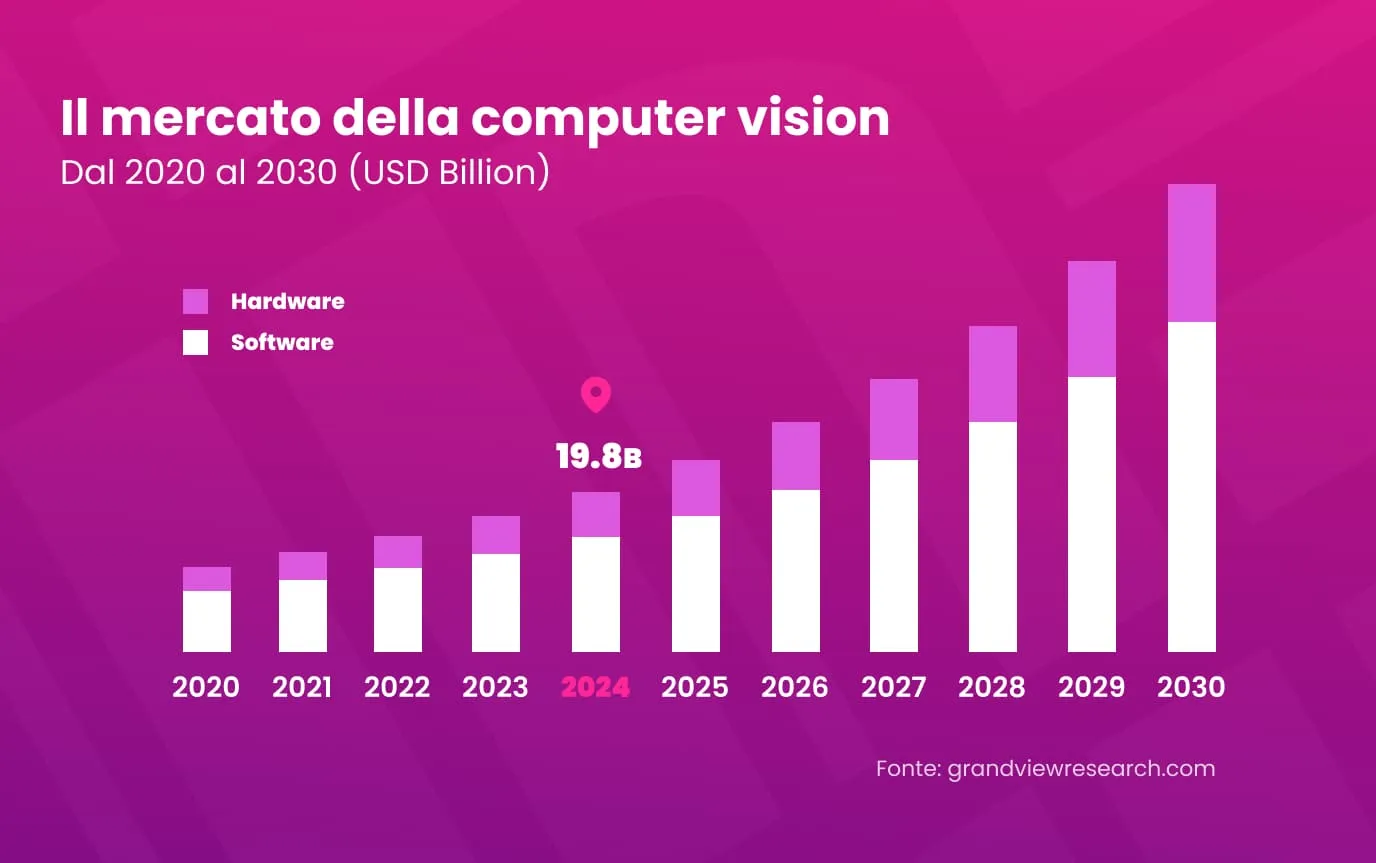
Computer vision is no longer just a technology trend: it is a key strategic asset that can unlock operational efficiencies, improve quality, strengthen security and create innovative customer experiences. Its market reached $19.83 billion in 2024 and is expected to grow by 19.8% a year in the coming years. Companies that manage to integrate this technology effectively into their processes will gain a significant competitive advantage.
So now is the time to actively assess how computer vision can be applied to solve specific challenges and seize new opportunities, transforming the way machines “see” and interact with the world.
Want to discover Neurally’s computer vision solution? It is our object detection software, which identifies objects, people and potential hazards in one or more sections of live or recorded video streams. We developed it and registered it with SIAE, the Italian authors’ and publishers’ society: a major project we believe in every day, and one that can transform your company’s business.
Discover the software
 Written byMartina Biscuola · CMO and co-founderBackground in sales and communication: she manages brand positioning and communication, and supports compliance and subsidised finance.
 Martina Biscuola